
Ereya (Immadi Pulikeshi): A Historical Study of the Greatest Chalukya Emperor
Ereya, popularly known in history as Immadi Pulikeshi or Pulakeshin II, was one of the most
influential rulers of the Badami Chalukya dynasty. His reign during the early seventh century CE
marked a turning point in the political history of the Deccan region. Through military skill,
administrative excellence, and cultural patronage, Ereya transformed the Chalukya kingdom into a
vast empire that commanded respect throughout the Indian subcontinent.
Born to King Kirtivarman I, Ereya was the rightful heir to the Chalukya throne. However, following
his father’s death, his uncle Mangalesha assumed power as regent. Over time, Mangalesha
attempted to secure the throne for his own son, leading to a succession dispute. Ereya challenged
this decision and fought for his inheritance. His victory over Mangalesha established him as the
legitimate ruler and demonstrated the determination that would later define his reign.
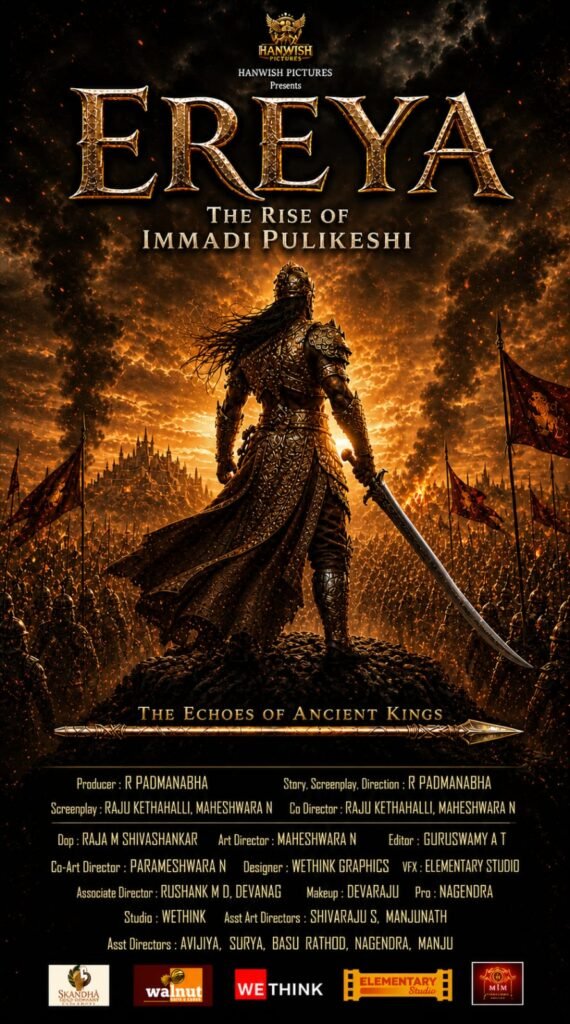

After ascending the throne around 610 CE, Ereya focused on consolidating power within the
kingdom. Several feudatories and neighboring rulers sought to exploit the transition of power, but
Ereya successfully suppressed these challenges. His early victories strengthened the foundations
of the Chalukya state and enabled him to pursue ambitious military campaigns across the Deccan.
One of Ereya’s most significant achievements was the expansion of the Chalukya Empire. Through
a series of campaigns, he defeated or subdued the Kadambas, Alupas, Gangas, Mauryas of
Konkan, Latas, Malavas, and Gurjaras. These victories extended Chalukya influence across large
portions of present-day Karnataka, Maharashtra, Andhra Pradesh, Gujarat, and neighboring
regions. His military successes established the Chalukyas as the dominant power in peninsular
India.
Ereya’s fame reached its peak through his confrontation with Emperor Harshavardhana of North
India. Harsha had unified much of northern India and sought to extend his influence southward. The
two powers eventually met near the Narmada River. Ereya successfully halted Harsha’s advance,
preserving the independence of the Deccan. This victory became one of the most celebrated
events in early medieval Indian history and elevated Ereya’s reputation throughout the
subcontinent.
The reign of Ereya was not defined solely by warfare. He was also an accomplished administrator
who maintained an efficient system of governance. Local authorities were granted responsibilities
while remaining loyal to the central government. Agriculture, trade, and commerce flourished under
his rule. Strategic trade routes connected the Deccan with other regions, contributing to economic
prosperity and stability.
The Chinese Buddhist monk and traveler Xuanzang visited the Chalukya kingdom during Ereya’s
reign. His observations describe a prosperous and well-governed realm with a disciplined
administration and content population. Xuanzang’s account remains one of the most valuable
contemporary sources for understanding the political and social conditions of the Chalukya Empire.
Ereya also played a crucial role in promoting art, architecture, religion, and literature. The Badami
Chalukya period witnessed the development of remarkable temple architecture, including
monuments at Badami, Aihole, and Pattadakal. These centers became important laboratories of
architectural innovation, blending northern and southern Indian styles. The artistic achievements of
the era continue to attract historians, archaeologists, and visitors from around the world
Despite his many successes, Ereya faced a formidable challenge from the Pallava dynasty of
Kanchipuram. Initially, he achieved victories against the Pallavas and extended his influence into
their territories. However, the Pallava ruler Narasimhavarman I later reorganized his forces and
launched a determined counteroffensive. Around 642 CE, Pallava forces captured Vatapi, the
Chalukya capital. Historical evidence suggests that Ereya likely died during or shortly before this
invasion.
The death of Ereya marked the end of one of the most remarkable reigns in Indian history.
Nevertheless, his legacy endured. Subsequent Chalukya rulers sought to restore the empire and
preserve the prestige he had established. His victory over Harsha, administrative accomplishments,
and contributions to culture ensured that his name remained synonymous with courage, leadership,
and imperial greatness.
Modern historians regard Ereya as one of the greatest monarchs of ancient and early medieval
India. His reign demonstrated how effective leadership could transform a regional kingdom into a
major imperial power. In Karnataka, he is remembered as a symbol of strength and statecraft, while
his achievements continue to occupy an important place in the broader history of India.
References: Major information about Ereya’s reign is derived from the Aihole Inscription composed
by Ravikirti, accounts of the Chinese traveler Xuanzang, archaeological evidence from Badami,
Aihole, and Pattadakal, and modern historical studies on the Badami Chalukya dynasty. These
sources collectively provide valuable insights into the political, military, administrative, and cultural
significance of Ereya’s rule.